
The Complete Guide to Making
High-Protein Ice Cream
with the Ninja Creami
This isn't a guide to making ice cream. It's a guide to making a high-protein dessert that fits your macros — ~350 calories, 40g+ protein per pint — using the Ninja Creami as the tool. The Pint Lab Method turns it into a repeatable, consistent habit.
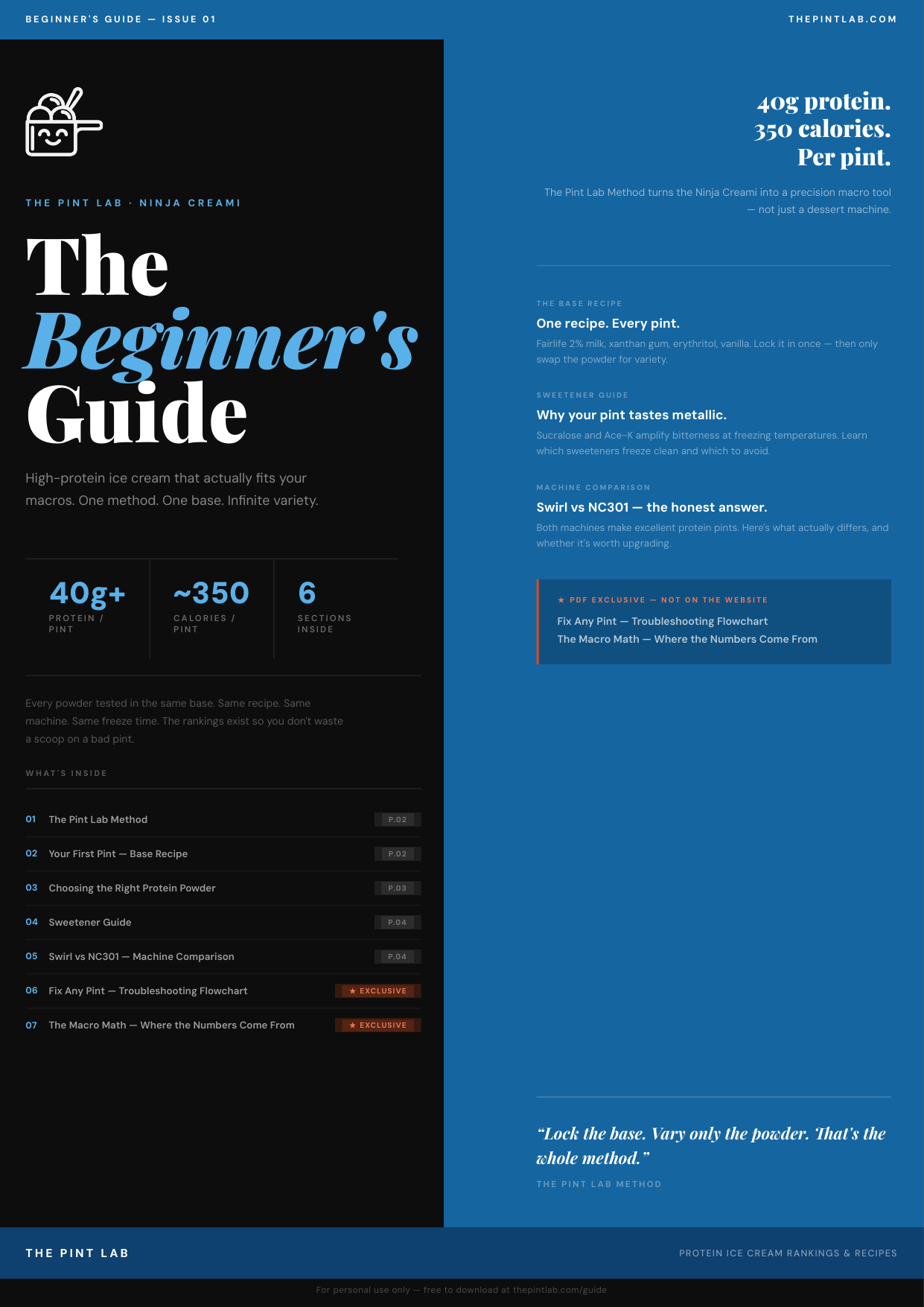
6-page PDF
Free PDF Guide
Save the complete guide — plus two exclusive sections
The PDF includes everything on this page, plus two sections you won't find anywhere else on the site:
★ Exclusive
Pint Troubleshooting Flowchart
Icy? Crumbly? Flat flavor? A visual decision tree that diagnoses your pint and tells you exactly what to fix.
★ Exclusive
Macro Math Breakdown
Exactly how the ~350 cal / 40g protein number is built, ingredient by ingredient. Full transparency on the numbers.
No spam. Unsubscribe anytime. Free to download from this site — personal use only.
What Is High-Protein Ninja Creami Ice Cream?
The Ninja Creami is a machine that processes frozen bases into ice cream by shaving and re-emulsifying the frozen block. What makes it uniquely suited to high-protein cooking is that it works with almost any frozen liquid — including protein shakes, Greek yogurt bases, and milk-powder blends that would never survive a traditional ice cream churn.
The result, when done right, is a full pint of dense, scoopable, genuinely satisfying ice cream with a macro profile that fits a serious fitness plan: roughly 350 calories and 40–45 grams of protein. That's more protein than most post-workout shakes, in a format that actually tastes like dessert.
This is not a compromise food. It's not "pretty good for healthy." When you use the right protein powder in the right base, the result is legitimately delicious — and it fits your macros without any mental math.
The Pint Lab Method
Most people approach the Ninja Creami like a recipe app — a new recipe every week, different ingredients, different macros, constant experimentation. The Pint Lab Method is the opposite. It's built on one insight: lock the base, vary only the protein powder and mix-ins.
Lock in the base recipe
One base. Always the same. Fairlife 2% milk, xanthan gum, non-fat milk powder, erythritol, vanilla, salt. No pudding mix, no maltodextrin. Weigh it, mix it, freeze it. Every pint hits the same macros: ~350 cal, 40g+ protein, low fat, low carb. You only have to figure this out once.
Get the standard recipe →Build your protein powder rotation
The protein powder is the only variable. That's the whole point. Vanilla Bean this week, Mint Chocolate next, Cookies & Cream after that. Same effort, same macros, completely different pint. The rankings exist so you don't waste a scoop on something that doesn't spin well or doesn't hit your protein goals.
See the full rankings →Stay consistent, hit your goals
Freeze for 24 hours, then spin. That's it. No new recipe to research, no new technique to learn. The consistency is what makes it work — for your taste buds and your macros. This is how you stay on track while actually enjoying the process.
Why this works for macros: When the base never changes, every pint hits the same protein, carbs, and calories. For people cutting, bulking, or maintaining — that predictability is everything. You're not estimating what you ate. You know. ~350 cal, 40g+ protein, every single time.
Your First Pint — The Base Recipe
This is the exact base used in every Pint Lab review. It's been refined to maximize protein, minimize calories, and produce a creamy texture regardless of which powder you use.
Ingredients (1 pint)
Weigh 375g of Fairlife 2% milk directly into an empty Ninja Creami pint container.
Add all remaining ingredients. Add the protein powder last.
Blend with an immersion blender for 30–45 seconds until fully smooth. No lumps.
Freeze with the lid slightly ajar for at least 16 hours. Overnight is ideal.
Spin on the Lite Ice Cream setting. If the result is crumbly or powdery, try a Re-spin first. If it's still powdery, add a splash of milk and Re-spin — this smooths it right out. Persistent powdery results are usually a recipe or powder issue, not a technique one.
For mix-ins: create a channel down the center, push mix-ins deep, then run the Mix-In cycle. This is what keeps the variety going — same base, same macros, completely different pint every time. Explore the Mix-In Lab →
Equipment You'll Need
Immersion Blender
NutriBullet — powerful but controlled in the pint container
AmazonKitchen Scale
For weighing 375g of milk accurately every time
AmazonAffiliate links — helps support the site at no extra cost to you.
Choosing Your Protein Powder
The protein powder is the single biggest variable in your pint. It determines flavor, texture, and macros. Not all powders behave the same when frozen — here's what to look for.
Protein source
Whey isolate and whey-casein blends spin the smoothest. Plant proteins can be grainy. Collagen goes rubbery. Beef isolate is hit or miss.
Sweetener
Erythritol and stevia freeze cleanly. Sucralose and Ace-K develop metallic bitterness when frozen — avoid powders heavy in these.
Macros
Target 20–25g protein per scoop, under 130 cal, low fat. This keeps the pint under 400 cal with 40g+ protein.
Flavor quality
If it doesn't taste good from the bag, it won't taste good frozen. The Creami concentrates flavor — it doesn't mask it.
Common Mistakes & Fixes
Most bad pints come down to one of these five mistakes. Each one has a straightforward fix.
Wrong protein powder
The #1 cause of icy, flat pints.
Not all protein powders behave the same when frozen. Whey isolates and whey-casein blends spin the smoothest. Plant proteins can be grainy. Collagen goes rubbery. Powders with sucralose or Ace-K develop a metallic bitterness when frozen. The Pint Lab rankings exist specifically to solve this — every powder is tested in the same base so you know what to expect before you buy.
Fix: Start with a powder ranked 7.0+ on The Pint Lab.
See the Rankings →Skipping the immersion blender
Undissolved powder = icy pockets.
Protein powder doesn't fully dissolve by stirring or shaking. Undissolved clumps freeze differently from the surrounding liquid, creating an uneven texture — dense in some spots, icy in others. A frother aerates the mix but doesn't fully incorporate the powder.
Fix: Blend with an immersion blender for 30–45 seconds after adding the powder.
Using skim milk or ultra-low-fat alternatives
Fat is what makes protein ice cream creamy.
The real culprit is skim milk or ultra-low-fat milks like unsweetened almond milk — they don't have enough fat or natural sugars to support a creamy texture. Without fat, water molecules freeze into large, crunchy crystals and the pint tastes flat even when the texture is passable. If you're lactose intolerant or avoiding dairy, oat milk or another milk with a bit more fat and natural sugar will get you much closer to the real thing. The extra ~20–50 calories is worth it.
Fix: Use Fairlife 2% milk (375g, weighed). Dairy-free? Try oat milk or a higher-fat plant milk — avoid skim and unsweetened almond milk.
See the Standard Recipe →Not freezing long enough
The machine needs a fully solid pint.
The Ninja Creami is calibrated for pints frozen solid at 0°F for at least 16–24 hours. Pints frozen for less time, or in a warm freezer, won't process correctly — the blade just mashes instead of shaving. If your freezer runs warm or is packed, go 36–48 hours.
Fix: Freeze for a minimum of 16–24 hours. Store in the back of a bottom drawer, not the door.
Spin Settings Explained
The Ninja Creami has several spin settings. For the standard high-protein pint, you'll use Lite Ice Cream almost every time. Here's what each setting does:
Pro tip: If your first spin comes out crumbly or powdery, just hit Re-spin — a second pass usually fixes it without adding anything. Only add a small splash of milk if the pint is very icy and dry.
Join the Community
Now that you know the basics, here's where to share your creations, get real-time help, and find new powders to try.